Chronicle of a death foretold is another masterpiece by Gabriel Garcia Marquez. The novella is a mystifying and gripping work, not in its construction of plot and storyline, of which there is none, but in its dive into the psychology of the society as a whole.
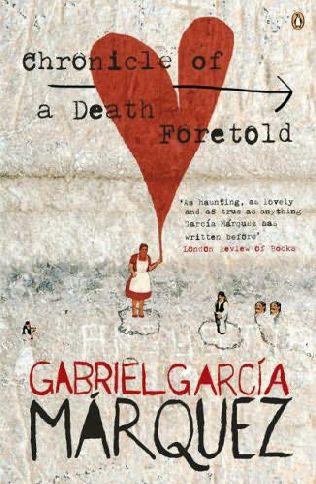
The entire novel is built around the murder of one Santiago Nasar who is believed to have dishonored Angela Vicario. Marquez has interestingly used pseudo-journalistic techniques in writing the Chronicle, but has refrained from giving any explanation of most of the facts as such. The narrator interviews the people about the murder which happened 27 years ago, collects evidences, and builds entire chronology of the murder. The plot is revealed in the title itself and as we read a little we know of the storyline completely. The rest of the novel then revolves around the responses of various individuals to the impending murder and on the pretext of building the story further, mocks the patriarchal Columbian society in the face.
In the Chronicle, Marquez comes much closer to social realism than he did in One Hundred Years of Solitude. We see in Chronicle how a few irrational traditions can prevail over reason for the entire populace. Marquez makes us realize how deep-seated the honor codes are in our sub-conscious and how we unknowingly adhere to them. Women are expected to follow a certain level of conduct, they are expected to be pure and virgin and shy while men are supposed to be tough emotionally and physically. Marquez's characters embrace this 'womanhood' and 'manhood' but its an imposed misery on them. Chronicle in this way acts as a satire on the traditional and ritualistic aspects of a society. Angela Vicario has to be returned to her parents' house after she is proved not to be a virgin. And though the groom lives his life in misery later, and the bride's brothers don't wish to kill the perpetrator, it becomes a matter of honor and actions have to be taken. Marquez makes his point, and does so in length throughout the novel without writing a word about it. That indeed is a beautiful aspect of Marquez's work.
Chronicle is an intricately woven piece, handcrafted with such a beauty that the reader is caught in its outer view and the detailed textures are missed. In a small almost hidden line we see the narrator proposing to his future wife, and how ironical this is to the larger context of the novel! And the note lying on the floor is perhaps Marquez's jab on the literary culture in the Latin America. The book is a farce on the torpidity of the people in the region. Every individual in the town has a foreknowledge of the murder but nobody tries to stop it. The murders are desperately awaiting some meddler who might reason with them and stop their act, but the entire townis unperturbed. And if the reader wants a reason for it, he is given none! He is just left to wonder or scorn at the happenings. the surprises aren't over yet. We never know what makes Angela say Santiago's name in the first place, much less about what drives her crazy over her ex husband. Such mystifying behaviors of the characters go on and are imbibed excellently in the story.
The social behavior notwithstanding, many other events bring out the surrealistic nature of the novel. Magical realism has always been Marquez's fortress and we see him using it in a diminished amount in the backdrop of his storytelling. So dreams are correctly interpreted, bullets cross walls to turn sculptures to dust, and spirits are talked to. The final killing, so brutal, is shown in so obvious a way that it could happen to anybody. Leave alone magical realism, even the symbolism in the Chronicle is overwhelming. While we see the bishop avoiding the town, we see the priest killing Santiago for “the second time” showing perhaps the bigger criminal of his death. This truly brings out Marquez's command on the language.
Marquez is indeed an artist when it comes to language, and Chronicle, a beautiful piece of art.
